你身边的生活百科全书

懂事百科

如何用代数方法求出两条线的交点

当直线在二维图形上相交时,它们只相交于一点,由一组坐标 x {\displaystyle x} -和 y {\displaystyle y} -表示。由于两条线都经过那个点,所以 x {\displaystyle x} -和 y {\displaystyle y} - 坐标必须同时满足两个方程。通过一些其他技巧,你就能以此类推,求出抛物线和其他二次曲线的交点。

当直线在二维图形上相交时,它们只相交于一点,由一组坐标 x {\displaystyle x} -和 y {\displaystyle y} -表示。由于两条线都经过那个点,所以 x {\displaystyle x} -和 y {\displaystyle y} - 坐标必须同时满足两个方程。通过一些其他技巧,你就能以此类推,求出抛物线和其他二次曲线的交点。

步骤

方法 1
方法 1 的 2:

求两条直线的交点

  1. 1
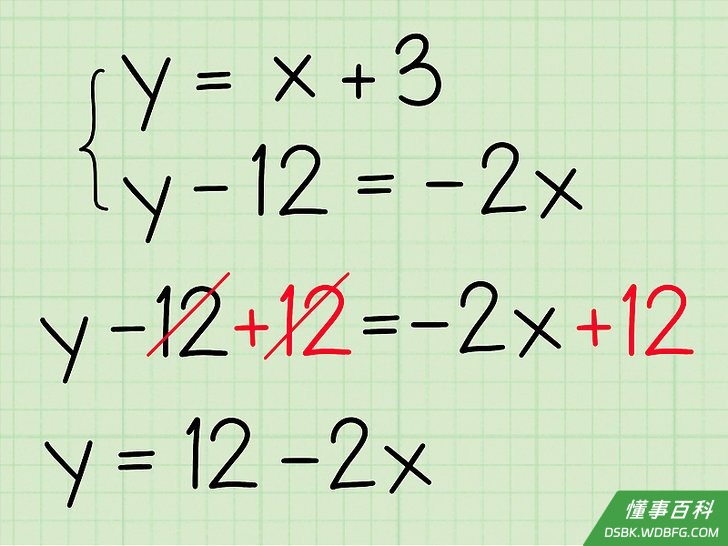
    写出每条直线的方程, y {\displaystyle y} 在等式左侧。如果有必要的话,重新排列等式,这样 y {\displaystyle y} 就单独在等号左侧。如果方程使用 f ( x ) {\displaystyle f(x)} g ( x ) {\displaystyle g(x)} ,而不是 y {\displaystyle y} ,那就将这一项单独分开。记住,你可以通过对等式两边执行相同的操作来消除这些项。

    • 如果你不会求这个方程,根据现有的信息求出直线方程。
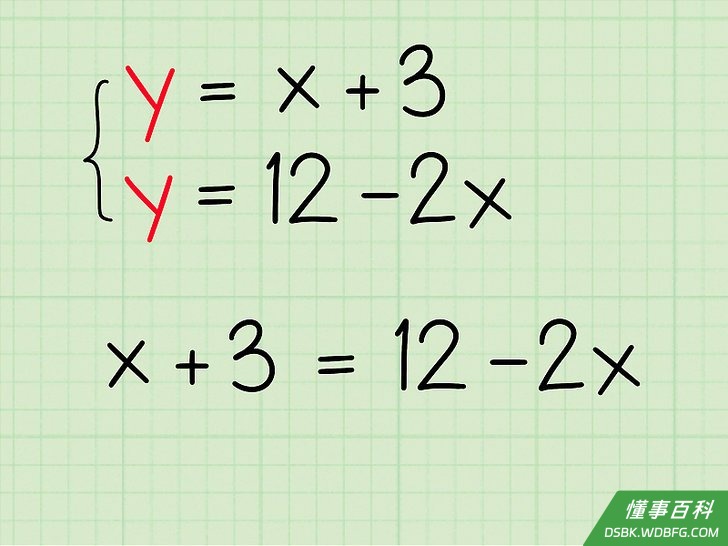
    • 例如:两条线分别为: y = x + 3 {\displaystyle y = x + 3} y 12 = 2 x {\displaystyle y - 12 = -2x} 。要想将第二个方程的 y {\displaystyle y} 分离出来,两边各加上12: y = 12 2 x {\displaystyle y = 12 - 2x}

  2. 2
    让两个等式右侧相等。我们在寻找一个点,两条直线在这个点上具有相同的 x {\displaystyle x} y {\displaystyle y} 值;这个点就是两条直线相交的位置。两个等式在左侧都是只有 y {\displaystyle y} ,这样我们就知道两个等式的右侧相等。写出一个新的方程来表示它。

    • 例如:已知 y = x + 3 {\displaystyle y = x + 3} y = 12 2 x {\displaystyle y = 12 - 2x} ,所以 x + 3 = 12 2 x {\displaystyle x + 3 = 12 - 2x}

  3. 3
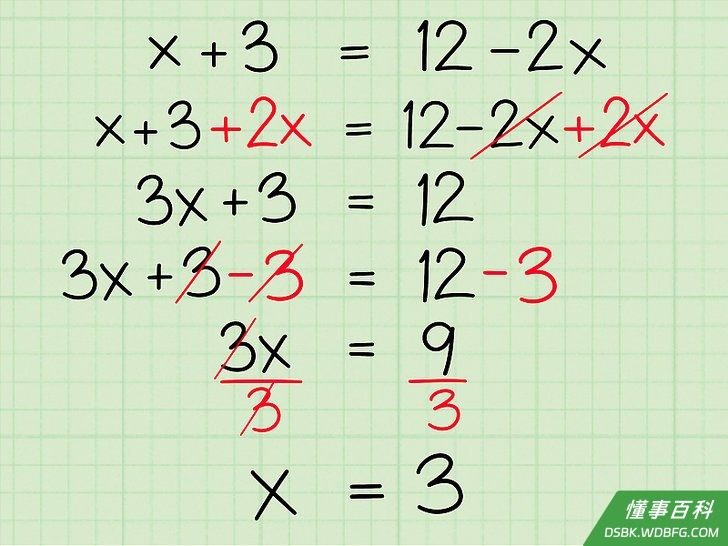
    求x新方程只有一个变量, x {\displaystyle x} 。用代数来解决这个问题,两边做同样的运算。把 x {\displaystyle x} 项移到等式的一边,然后将它写成 x = ? ? {\displaystyle x = ??} 的形式。(如果不行,那就跳到这一部分的最后一步。)

    • 例如: x + 3 = 12 2 x {\displaystyle x + 3 = 12 - 2x}
    • 两边各加上 2 x {\displaystyle 2x}
    • 3 x + 3 = 12 {\displaystyle 3x + 3 = 12}
    • 每边减去3:
    • 3 x = 9 {\displaystyle 3x = 9}
    • 两边各除以3:
    • x = 3 {\displaystyle x = 3}

  4. 4
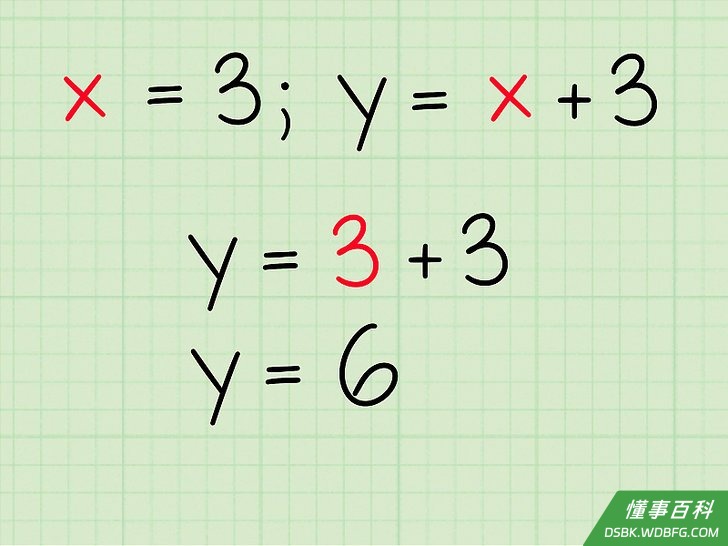
    用这个 x {\displaystyle x} -值来求解 y {\displaystyle y} 选择一条直线的方程。将你求出的x值带入这个等式中的所有 x {\displaystyle x} 。算一下算式,求出 y {\displaystyle y}

    • 例如: x = 3 {\displaystyle x = 3} y = x + 3 {\displaystyle y = x + 3}
    • y = 3 + 3 {\displaystyle y = 3 + 3}
    • y = 6 {\displaystyle y = 6}

  5. 5
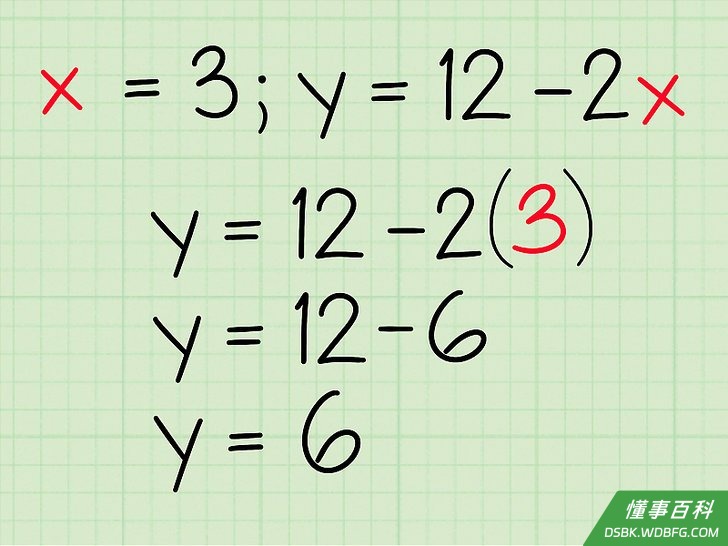
    检查计算结果。 x {\displaystyle x} -值带入另一个方程中来查看是否得到相同的结果,这是一种很好的做法。如果你得到不同的 y {\displaystyle y} 值,回去检查你的计算过程,检查计算错误。

    • 例如: x = 3 {\displaystyle x = 3} y = 12 2 x {\displaystyle y = 12 - 2x}
    • y = 12 2 ( 3 ) {\displaystyle y = 12 - 2(3)}
    • y = 12 6 {\displaystyle y = 12 - 6}
    • y = 6 {\displaystyle y = 6}
    • 两次计算结果一致。没有错误。

  6. 6
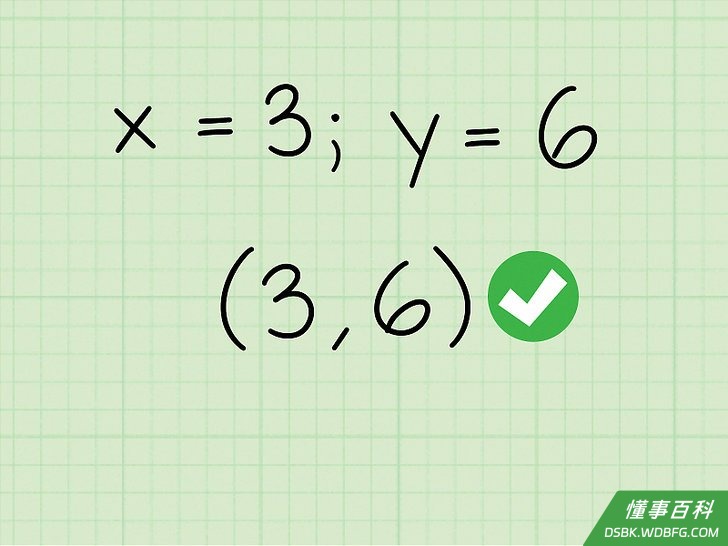
    写出交点的 x {\displaystyle x} y {\displaystyle y} 坐标。现在,你已经求出两条直线交点的 x {\displaystyle x} -值和 y {\displaystyle y} -值。将这个交点写成坐标组, x {\displaystyle x} -值作为第一个值。

    • 例如: x = 3 {\displaystyle x = 3} y = 6 {\displaystyle y = 6}
    • 这两条直线相交于(3,6)。

  7. 7
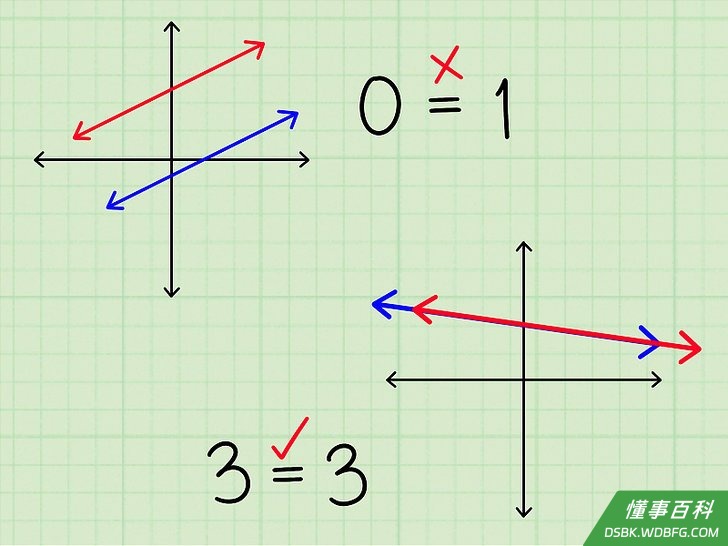
    处理异常结果。有些方程是不可能解出来 x {\displaystyle x} 的。这不一定是你出错了。两条直线有两种方式会导致出现特殊结果:

    • 如果两条直线平行,它们不相交。 x {\displaystyle x} 项就会抵消,方程就会简化成错误的表述(例如 0 = 1 {\displaystyle 0 = 1} )。可以写出“这两条直线不相交”或“没有实数解”作为答案。
    • 如果两个方程描述的是同一条直线,直线上的所有点都“相交”。 x {\displaystyle x} 项抵消,方程就会简化成一个正确的表述(例如 3 = 3 {\displaystyle 3 = 3} )。可以写出“这两条直线是同一条”作为答案。
方法 2
方法 2 的 2:

二次方程问题


  1. 1
    识别二次方程。在二次方程中,一个或多个变量的高次数是2( x 2 {\displaystyle x^{2}} y 2 {\displaystyle y^2} ),没有更高的次数。这些方程表示是曲线,所以它们和直线的交点数量可以是0、1或2。本部分将教你如何求出0、1或2个交点。

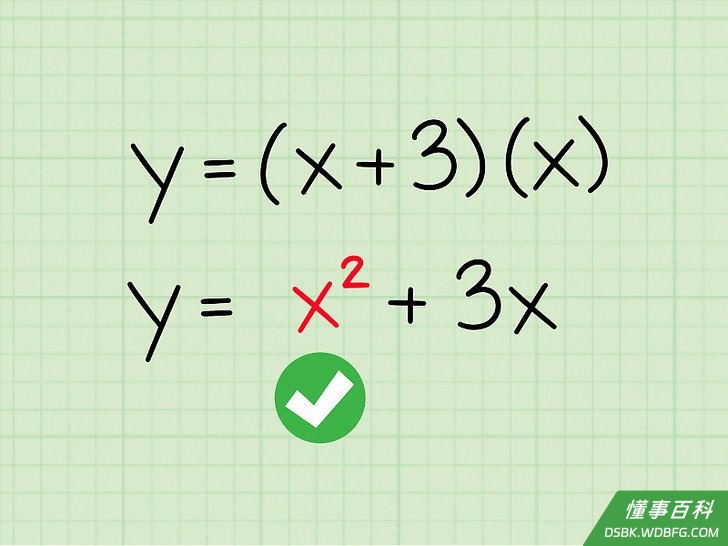
    • 用展开方程的括号,检查它是否是二次方程。例如, y = ( x + 3 ) ( x ) {\displaystyle y = (x + 3)(x)} 是二次方程,因为它可以展开为 y = x 2 + 3 x {\displaystyle y = x^2 + 3x}
    • 圆或椭圆的方程 x 2 {\displaystyle x^{2}} y 2 {\displaystyle y^2} 项。如果你在处理这些特殊情况时遇到困难,请参阅下面的“小技巧”部分。

  2. 2
    把方程写成y的形式。如果有必要的话,把每个方程重写一下,使y单独在等式的一边。

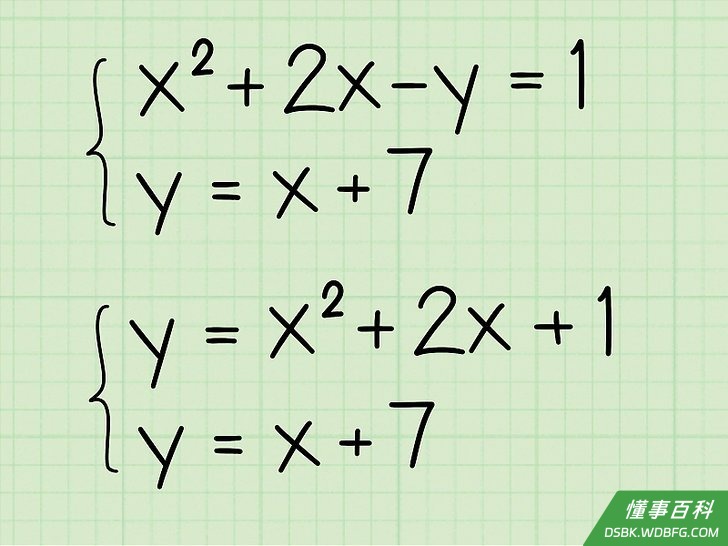
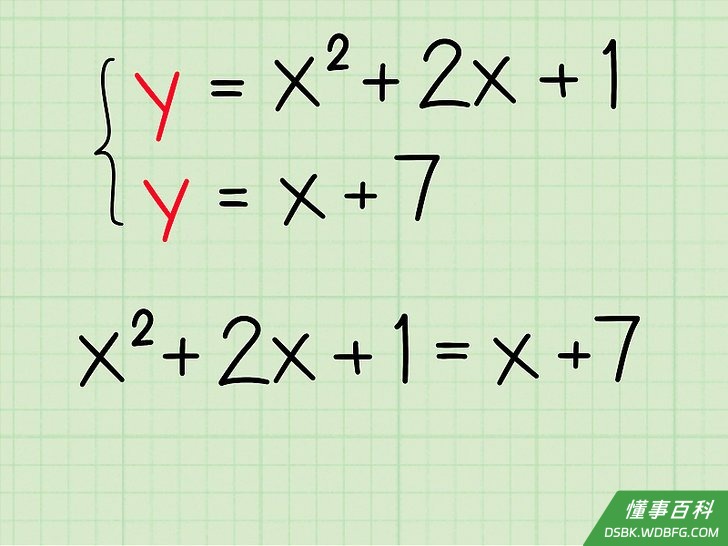
    • 例如:求出 x 2 + 2 x y = 1 {\displaystyle x^2 + 2x - y = -1} y = x + 7 {\displaystyle y = x + 7} 的交点。
    • 用y表示二次方程:
    • y = x 2 + 2 x + 1 {\displaystyle y = x^2 + 2x + 1} y = x + 7 {\displaystyle y = x + 7}
    • 本例中有一个二次方程和一个线性方程。两个二次方程的问题可以用类似的方法求解。

  3. 3
    结合两个方程来消去y,两个方程左侧都为y时,你就知道两个方程的右侧是相等的。

    • 例如: y = x 2 + 2 x + 1 {\displaystyle y = x^2 + 2x + 1} y = x + 7 {\displaystyle y = x + 7}
    • x 2 + 2 x + 1 = x + 7 {\displaystyle x^2 + 2x + 1 = x + 7}

  4. 4
    把新方程整理一下,让一边等于0。使用标准的代数方法把所有的项都移到一边。这样问题就解决了,我们可以在下一步中解决这个问题。

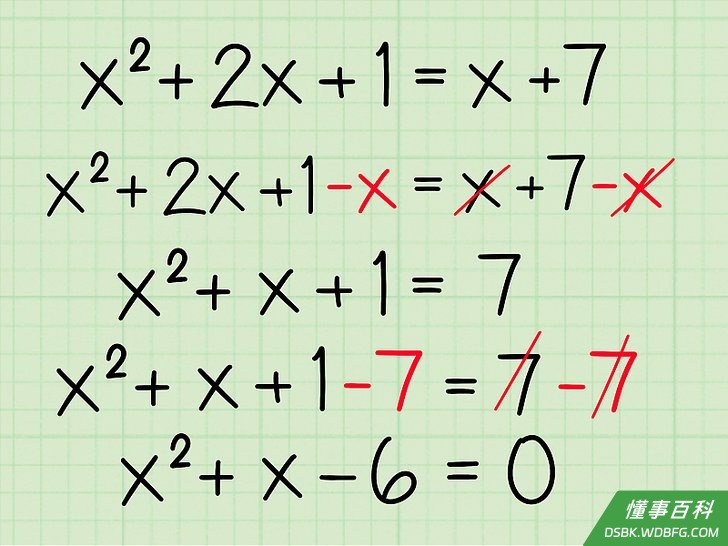
    • 例如: x 2 + 2 x + 1 = x + 7 {\displaystyle x^2 + 2x + 1 = x + 7}
    • 两边同时减去x:
    • x 2 + x + 1 = 7 {\displaystyle x^2 + x + 1 = 7}
    • 两边同时减去7:
    • x 2 + x 6 = 0 {\displaystyle x^2 + x - 6 = 0}

  5. 5
    解二次方程当你让等式一边等于0,有三种方法可以解一个二次方程。不同人会觉得不同方法会更简单。你可以阅读二次方程式,或者“给二次方程式配方”,或者按照这个 因式分解方法例子:

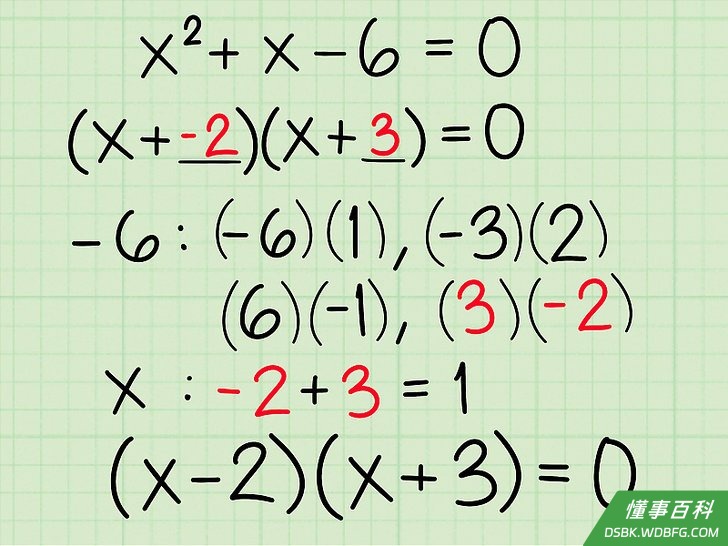
    • 例如: x 2 + x 6 = 0 {\displaystyle x^2 + x - 6 = 0}
    • 因式分解的目的是找出两个因子相乘得到这个方程。从第一项开始,我们可以将 x 2 {\displaystyle x^{2}} 分为x乘以x。写成(x    )(x    ) = 0。
    • 最后一项为-6。列出每一对相乘为- 6的因子: 6 1 {\displaystyle -6 * 1} 3 2 {\displaystyle -3 * 2} 2 3 {\displaystyle -2 * 3} 1 6 {\displaystyle -1 * 6}
    • 中间项为x(你可以写成1x)。把每对因子相加,直到得到1为止。正确的因子对为 2 3 {\displaystyle -2 * 3} ,因为 2 + 3 = 1 {\displaystyle -2 + 3 = 1}
    • 用这对因子来填在空白处: ( x 2 ) ( x + 3 ) = 0 {\displaystyle (x - 2)(x + 3) = 0}

  6. 6
    留意x的两个解。如果你算得太快,你可能只找到了一个解,却没有意识到还有第二个解。下面是如何找到这两条线相交于两点的两个x值:

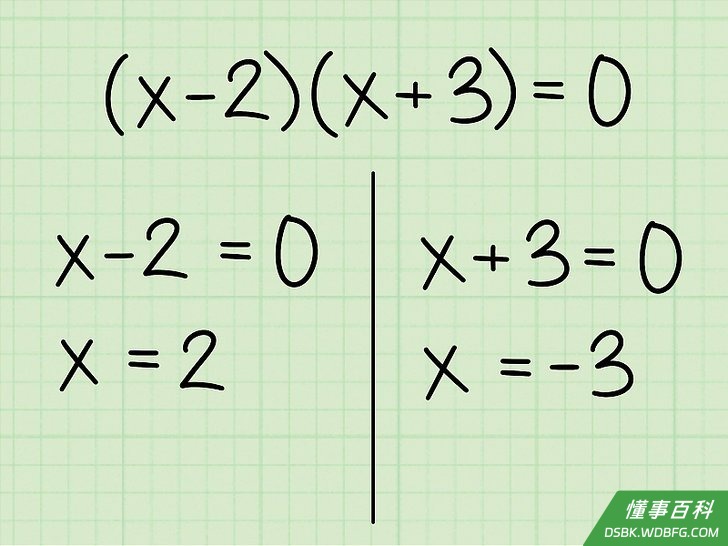
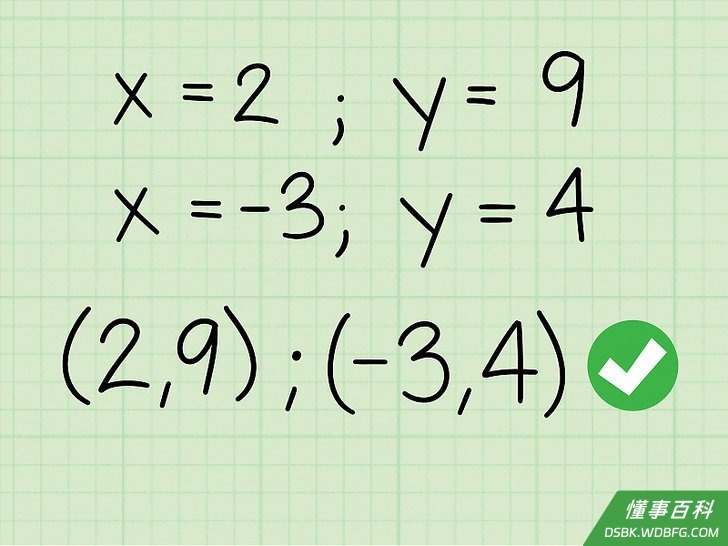
    • 例如(因式分解):我们得到方程 ( x 2 ) ( x + 3 ) = 0 {\displaystyle (x-2)(x+3) = 0} 。如果括号中的任意一个因式为0,则这个方程为真。一个解为 x 2 = 0 {\displaystyle x - 2 = 0} x = 2 {\displaystyle x = 2} 。另一个解为 x + 3 = 0 {\displaystyle x + 3 = 0} x = 3 {\displaystyle x = -3}
    • 例如(二次方程或完成平方):如果你用这些方法来解方程,就会出现平方根。例如,这个方程变成 x = ( 1 + 25 ) / 2 {\displaystyle x = (-1+\sqrt{25})/2} 。记住,一个平方根可以简化成两个不同的解: 25 = 5 5 {\displaystyle \sqrt{25} = 5 * 5} 以及 25 = ( 5 ) ( 5 ) {\displaystyle \sqrt{25} = (-5) * (-5)} 。写出两个方程,每个对应一种可能性,然后分别解出x。

  7. 7
    求出一个或零个解。两条几乎没有相交的线只有一个交点,而两条完全不相交的线则没有交点。以下是如何求出这些解:

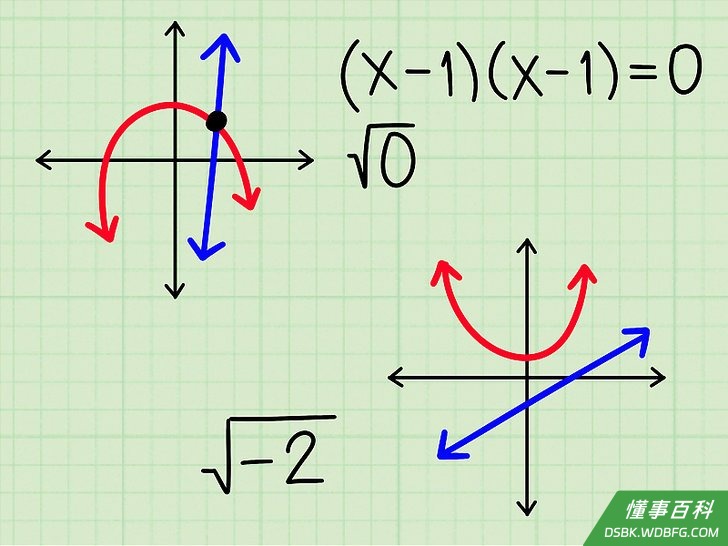
    • 1个解:方程分解成两个相同的因式((x-1)(x-1) = 0)。当代入二次方程时,平方根项是 0 {\displaystyle \sqrt{0}} 。你只需要解一个方程。
    • 无实数解:没有满足要求的因子(对中间项求和)。代入二次方程,得到根号下的负数(例如 2 {\displaystyle \sqrt{-2}} )。答案为“无实数解”。

  8. 8
    把x值代回原方程。求出交点的x值后,把它代回开始时的方程。解出y,求出y值。如果有第二个x值,也重复这个操作。

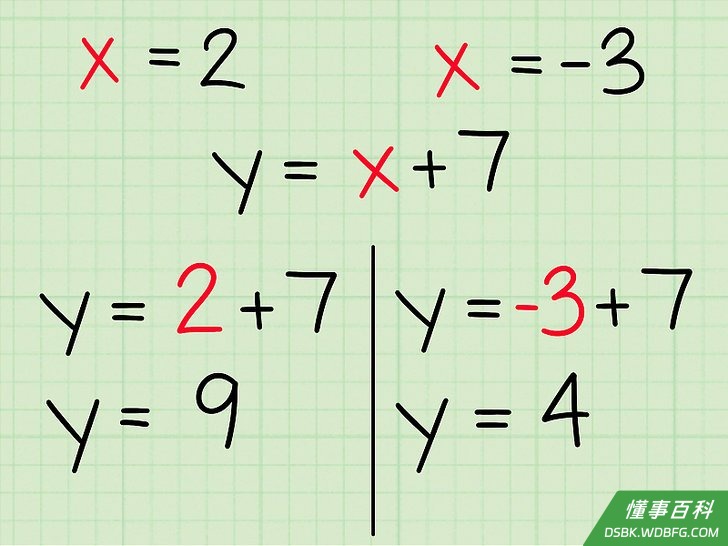
    • 例如:我们求出两个解, x = 2 {\displaystyle x = 2} x = 3 {\displaystyle x = -3} 。其中一条直线的方程为 y = x + 7 {\displaystyle y = x + 7} 。带入x: y = 2 + 7 {\displaystyle y = 2 + 7} y = 3 + 7 {\displaystyle y = -3 + 7} ,然后解出每个方程,得到 y = 9 {\displaystyle y = 9} y = 4 {\displaystyle y = 4}

  9. 9
    写出交点坐标。现在把答案写成坐标形式,用交点的x值和y值表示。如果你有两个答案,确保匹配正确的x值和y值。

    • 例如:当我们带入 x = 2 {\displaystyle x = 2} ,可以得到 y = 9 {\displaystyle y = 9} ,所以一个交点为(2, 9)。用同样的方法求出第二个解得出另一个交点为(-3, 4)

小提示

  • 圆或椭圆的方程有一个 x 2 {\displaystyle x^{2}} 一个 y 2 {\displaystyle y^2} 项。要想求圆与直线的交点,需要解线性方程中的x。把x的解代入圆方程,你会得到一个更简单的二次方程。这个方程可能有0个、1个或2个解,如上面的方法所述。
  • 一个圆和一个抛物线(或其他二次型)可能有0、1、2、3或4个解。在两个方程中找出平方的变量——假设它是x。求出 x 2 {\displaystyle x^{2}} ,并带入另一个方程中的 x 2 {\displaystyle x^{2}} 。求解y,得到0、1、或2个解。把每个解代入原来的二次方程,解出x,每个方程都可能有0、1或2个解。

暂无评论